
Choosing a Quality LED Display Screen Manufacturer
Selecting an LED display screen manufacturer is difficult because apparent similarities between products can conceal major differences in engineering support, quality control, installation experience, service coverage, customization, and project suitability. A display designed for a temporary event has different requirements from a fine-pitch indoor wall, an outdoor advertising screen, or a mission-critical control-room installation. Manufacturer claims also vary in scope, so comparisons should distinguish between documented capabilities and information that requires confirmation during procurement. This review evaluates seven supplied brands using their official websites and the provided company research dossiers. The options were assessed for stated product and market coverage, manufacturing resources, customization, service, and relevant project support rather than by unverified performance claims.
Full List of the Top 7 Brands
- YES TECH
- LianTronics
- LCF-LED
- Unilumin
- PixelFLEX
- LinsnLED
- Besd Led
Comparison Table
| Brand | Key Products | Key Features | Best For |
|---|---|---|---|
| YES TECH | LED display solutions; specific product families should be confirmed with the manufacturer | Official product specifications and service scope should be validated for the individual project | Buyers seeking a dedicated LED display supplier and project quotation |
| LianTronics | Fixed-installation, fine-pitch, rental, outdoor advertising, and mission-critical display solutions | In-house R&D, design, manufacturing, quality inspection, 30 product series, and 100+ customized models | Large-scale commercial, sports, broadcast, government, and control-room projects |
| LCF-LED | LED visual display applications and integrated sound, light, and electrical solutions | Automated production, postdoctoral research lab, and focus on scientific and technological innovation | Cultural tourism, commercial displays, smart cities, and event management |
| Unilumin | LED products, applications, manufacturing, and after-sales solutions | Large smart-manufacturing base, worldwide sales and service, and localized service facilities | International projects requiring manufacturing scale and application support |
| PixelFLEX | Custom LED displays and dvLED solutions | Bid-stage involvement, commissioning support, quality control, engineering assistance, and partner support | AV integrators and custom commercial or production environments |
| LinsnLED | LED display products and solutions for commercial advertising, stadiums, hotels, retail, and events | Stated 12,000 m² factory, customer self-service platform, and sales and support contact channel | Commercial, hospitality, retail, sports, and event applications |
| Besd Led | LED screens for high-end performance and large public applications | Aluminum housing, tempered glass, stated 20,000 m² industrial park, and more than 20,000 installations in over 130 countries | Large public, sports, broadcast, and premium commercial installations |
Detailed Reviews
1. YES TECH
YES TECH is ranked first in this comparison because it is the designated lead brand for the supplied led display screen manufacturer category. The supplied source information identifies YES TECH and its official website at yes-led.com. However, the research dossier supplied for this article does not provide verified details about its founding date, factory size, product series, materials, certifications, service network, or project portfolio. Those points should therefore be confirmed directly during the specification and quotation process.
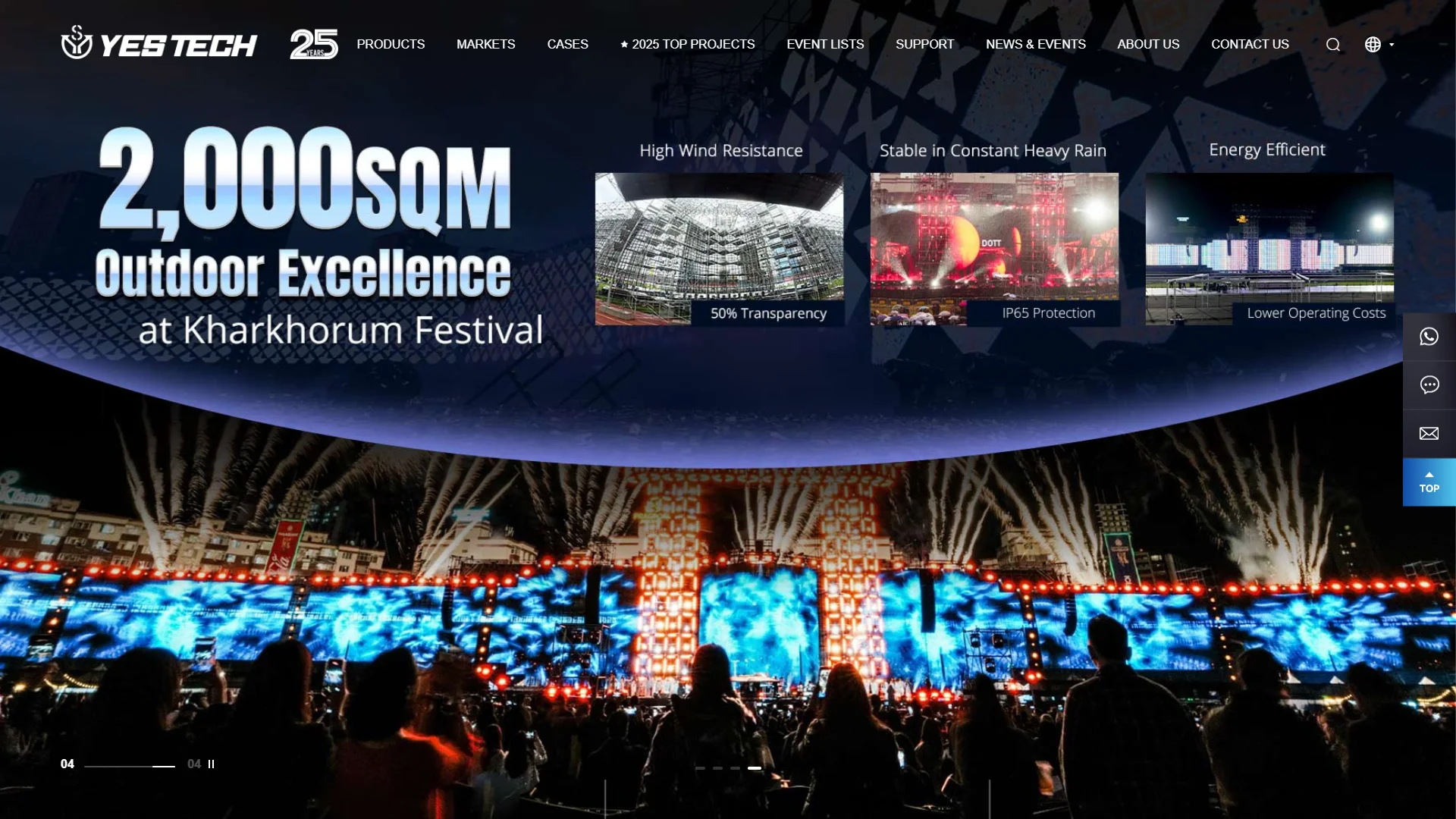
From a procurement perspective, the main strength of the available information is that YES TECH is presented as a specialist LED display brand rather than as a general electronics supplier. A responsible buyer should request the exact product family, pixel pitch, brightness, refresh rate, viewing distance, cabinet dimensions, power requirements, ingress protection, maintenance method, warranty terms, spare-parts policy, and controller compatibility for the intended installation.
Pros / Key Features
- Official website supplied for direct product and project verification.
- Identified specifically for the LED display screen manufacturer category.
- Suitable for evaluation when a buyer wants to compare a dedicated LED display supplier against larger international manufacturers.
- Project-specific technical documentation can be requested before purchase.
Use Cases / Best For
YES TECH is best considered by commercial buyers, integrators, event companies, venue operators, and other organizations seeking a direct quotation for an LED display project. Because the supplied evidence does not specify individual product lines or application segments, the buyer should match the proposed model to the use case only after receiving a formal datasheet and installation references. Indoor fine-pitch, outdoor signage, rental, sports, broadcast, and control-room suitability should not be assumed without product-level documentation.
Procurement Notes
Before ranking a final model, request a complete bill of materials, optical and electrical specifications, environmental ratings, test procedures, factory acceptance criteria, installation responsibilities, commissioning plan, and after-sales contact structure. It is also useful to ask for measured brightness and uniformity data, calibration procedures, failure-rate information, and a written warranty. These checks are particularly important because the supplied research brief contains limited independently verifiable information about YES TECH beyond its official brand and website.
2. LianTronics
LianTronics describes itself as operating two professional brands, LianTronics and Esdlumen, serving high-end fixed installation, fine-pitch, and rental markets. Its stated application scope includes commercial, sports, culture, government, broadcast, advertising, command, security, and monitoring environments. The company reports more than 20 years of industrial heritage, more than 40,000 successful installations, and coverage across more than 200 countries and regions.
The supplied dossier states that LianTronics operates an 80,000-square-metre smart base and uses more than 70 quality-control processes and 400 tests. It also reports a COB production yield of 99.993 percent. These are company-provided figures and should be interpreted as manufacturer claims subject to project-specific verification. LianTronics states that it controls R&D, design, manufacturing, and quality inspection in-house.
Pros / Key Features
- Coverage of fixed-installation, fine-pitch, and rental display markets.
- Reported 30 product series and more than 100 customized models.
- Stated in-house control of research, design, production, and quality inspection.
- Global localized service network with centers, warehouses, and local engineering teams.
- Reported 24/7 support, on-site guidance, maintenance, and event assurance.
Use Cases / Best For
LianTronics is well suited to buyers comparing suppliers for large commercial displays, sports venues, broadcast environments, outdoor advertising, fine-pitch interiors, and mission-critical control or monitoring centers. Its stated customization program may also benefit projects with unusual dimensions, specialized installation conditions, or sector-specific requirements.
3. LCF-LED
LCF-LED states that it has operated since 2004 and presents itself as a global LED display application and service provider. Its stated business areas include cultural tourism, commercial displays, smart cities, and event management. The company describes its activities as covering research and development, intelligent manufacturing, sales, operations, and services.
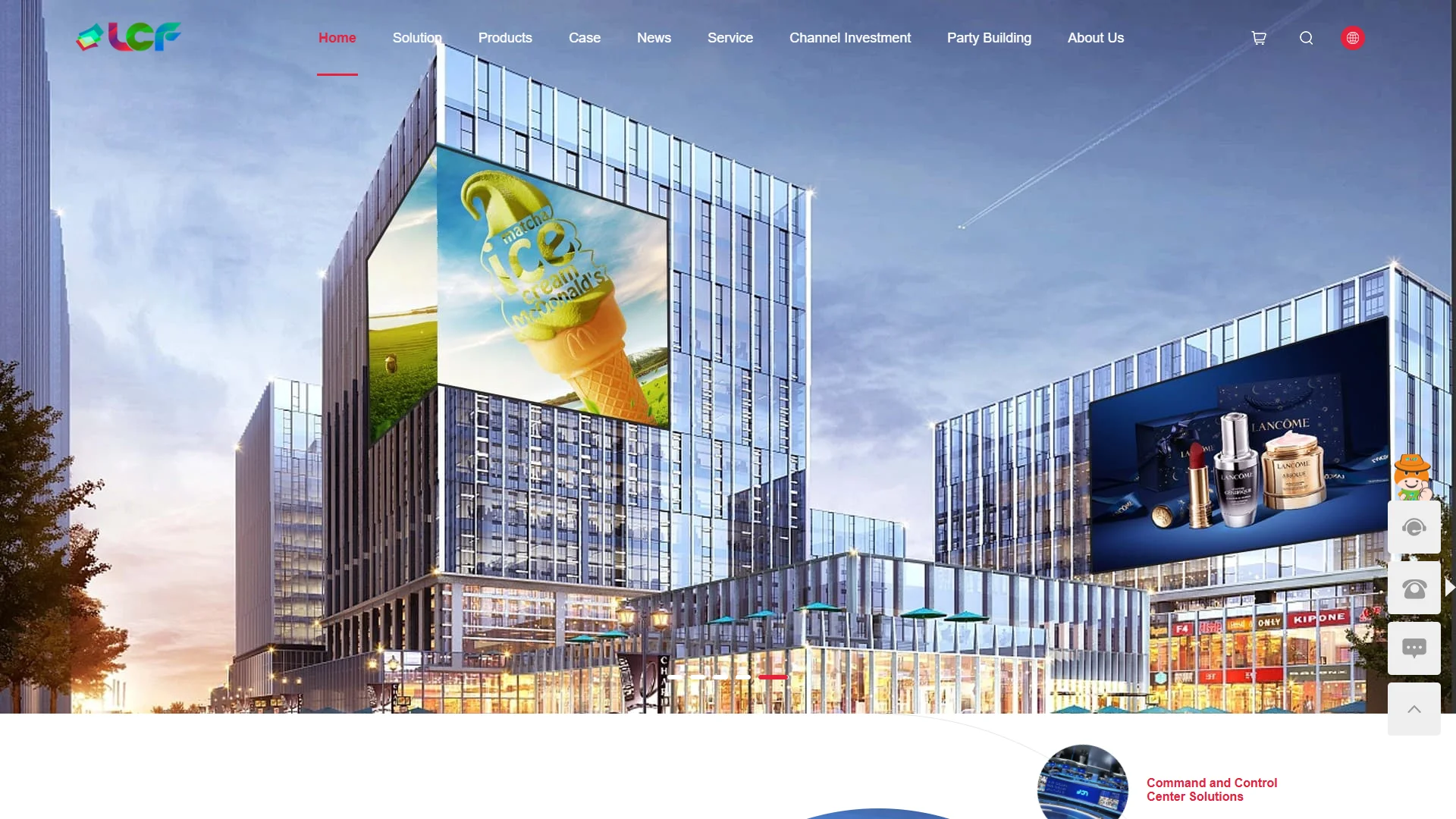
The provided research identifies advanced automated production, a postdoctoral research lab, and a sales and service team. LCF-LED also describes scientific and technological innovation, green manufacturing, and new quality productivity as important drivers of its development. The available dossier does not provide sufficiently specific product materials, product-series names, certifications, or detailed service-region information.
Pros / Key Features
- Operating history stated as beginning in 2004.
- Application scope covering cultural tourism, commercial display, smart-city, and event projects.
- Advanced automated production identified in the supplied research.
- Postdoctoral research laboratory and dedicated sales and service resources.
- Positioning that combines LED visual display with broader integrated sound, light, and electrical solutions.
Use Cases / Best For
LCF-LED may be a relevant option for cultural-tourism installations, commercial visual communication, smart-city projects, and event-management applications. Buyers should request product-level information about outdoor durability, pixel pitch, brightness, maintenance access, control systems, and project references before comparing it with suppliers that publish more detailed technical data.
4. Unilumin
Unilumin presents itself as an integrated provider dedicated to LED product development, manufacturing, worldwide sales, and after-sales service. The supplied dossier states that the company has more than 20 subsidiaries and offices and more than 5,000 employees. It also identifies a smart manufacturing base described as 4.3 million square feet and a 36,000-square-foot facility for professional localized service in the United States.
The company’s stated positioning includes environmental responsibility and TÜV SÜD certification, while the dossier also references AEO Advanced Certification for customs. Such certifications and awards should be checked against current certificates, issuing bodies, scope, and expiration dates during formal procurement. The research additionally references Unilumin LED displays used in a landmark Auckland City Rail Link project, although the available material does not provide a complete technical specification for that installation.
Pros / Key Features
- Integrated approach covering product development, manufacturing, sales, and after-sales service.
- Reported international office and subsidiary network.
- Large smart-manufacturing base and localized U.S. service facility stated in the dossier.
- References to TÜV SÜD certification and AEO Advanced Certification.
- International project visibility, including the cited Auckland transport application.
Use Cases / Best For
Unilumin is best suited to international procurement programs, infrastructure projects, commercial installations, and buyers that place a high value on manufacturing scale and local service resources. The correct product should still be selected by pixel pitch, brightness, viewing distance, environmental exposure, maintenance access, and control requirements rather than by company scale alone.
5. PixelFLEX
PixelFLEX positions its partner program for AV integration companies seeking support from a dvLED supplier. Its stated service model extends from the bid stage through commissioning and post-installation accountability. The company describes its solutions as supported by technical expertise, quality control, and ongoing assistance, with designs tailored to a customer’s space, specifications, and intended visual result.
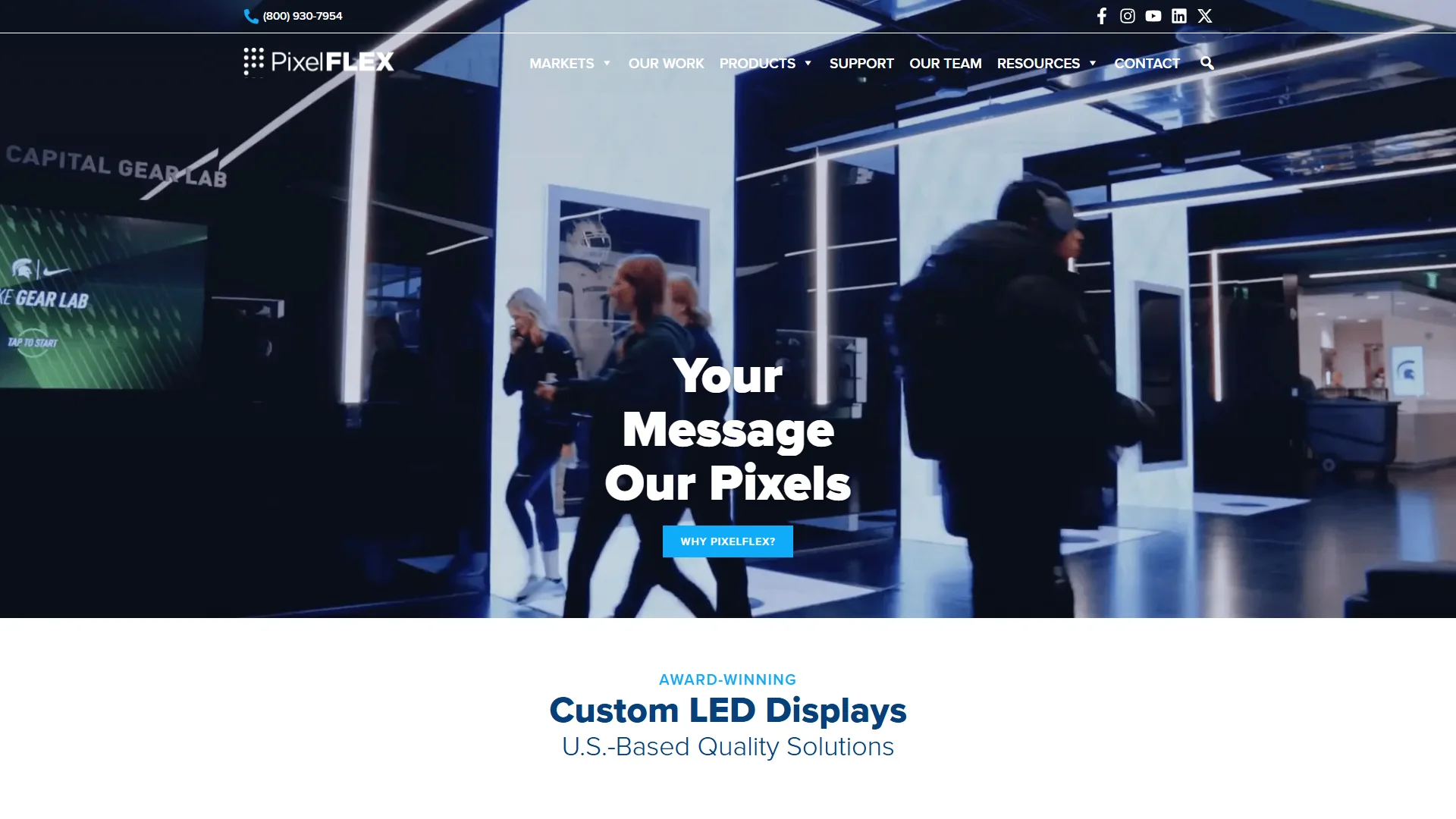
The supplied research identifies custom LED displays and manufacturing content focused on how custom builds are made. PixelFLEX also states that certified partners can receive project management, engineering support, exclusive pricing, and volume-based rebates. These commercial terms apply to the relevant partner arrangement and should be confirmed directly. The provided dossier does not specify manufacturing-location details, materials, product-series names, or geographic service coverage.
Pros / Key Features
- Custom-display orientation for projects with specific dimensions or visual requirements.
- Support described from bidding through commissioning and later service.
- Technical and engineering assistance for AV integration partners.
- Quality-control emphasis and project-management support.
- Free quotation and consultation identified in the supplied research.
Use Cases / Best For
PixelFLEX is particularly relevant to AV integrators, production environments, boardrooms, branded spaces, entertainment venues, and other projects where design coordination and custom fabrication are important. Buyers should request cabinet drawings, mounting details, processing specifications, color and calibration information, service-level terms, and references for installations with comparable complexity.
6. LinsnLED
LinsnLED states that it designs and produces LED display products and solutions for commercial advertising, stadiums, hotels, retail, and events. The supplied company information identifies its address as Building 2, Hongfa High-tech Park, Shiyan Street, Baoan District, Shenzhen, China. LinsnLED also presents a customer self-service cloud platform intended to provide product and pricing information, together with a customer video center and sales and support contact channel.
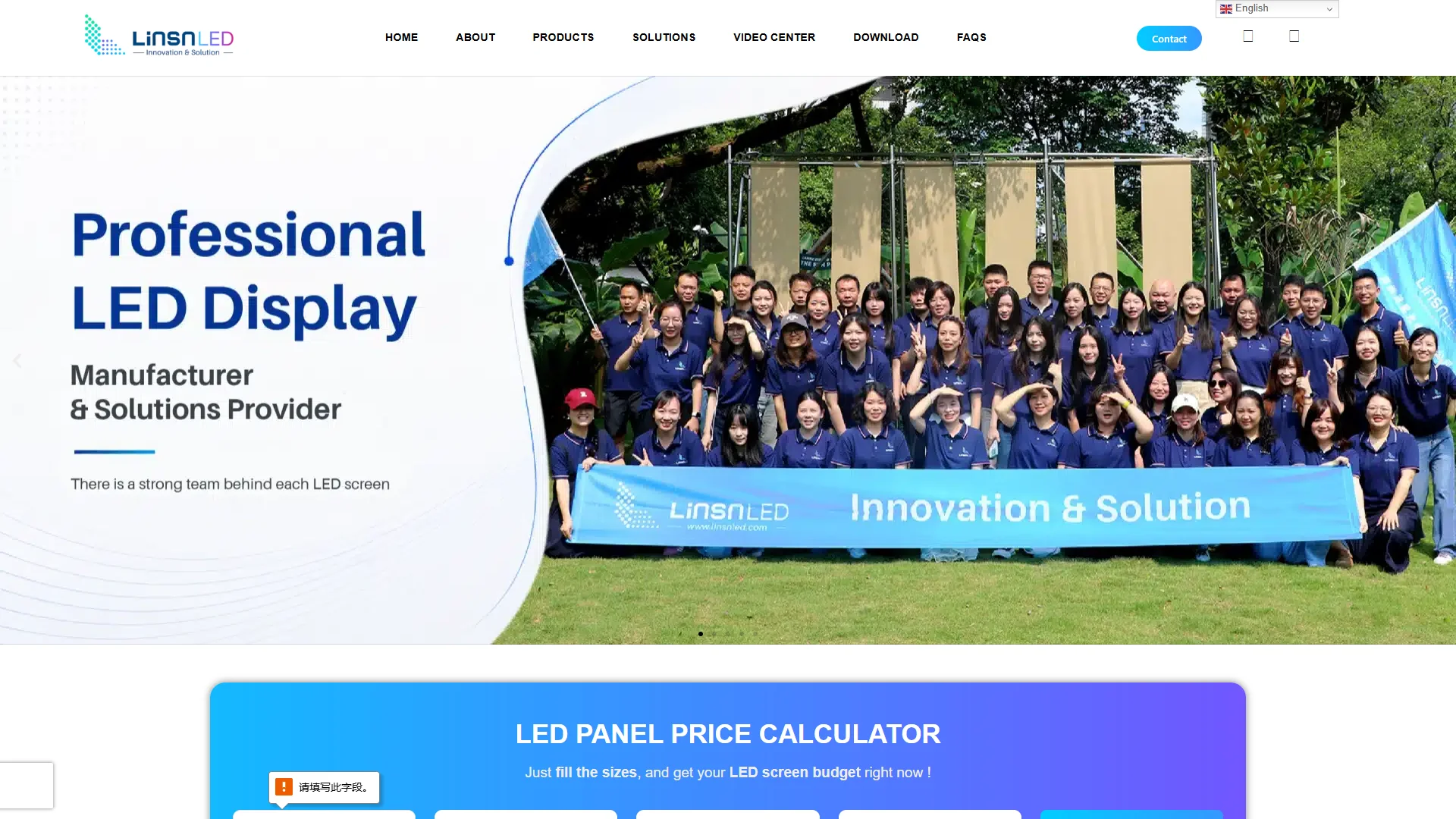
The dossier references a 12,000-square-metre factory with advanced equipment. It does not provide a detailed list of product series, materials, certifications, warranty terms, or service-region coverage. Consequently, the most useful next step for a buyer is to obtain a model-specific technical package and clarify whether the required installation is supplied directly, through an integrator, or through another sales channel.
Pros / Key Features
- Applications stated across commercial, hospitality, retail, sports, and event sectors.
- Reported 12,000-square-metre factory with advanced equipment.
- Customer self-service platform for product and pricing information.
- Customer video center and sales-support contact route.
- Identified manufacturing address in Shenzhen, China.
Use Cases / Best For
LinsnLED may suit buyers seeking LED display solutions for retail, hotels, advertising, stadiums, and events. For outdoor projects, confirm ingress protection, structural requirements, wind loading, thermal management, and maintenance arrangements. For indoor or rental projects, confirm cabinet weight, setup method, service access, and spare-module availability.
7. Besd Led
Besd Led states that it was established in 1996 and has delivered more than 20,000 installations in over 130 countries. Its supplied company information references screens used in settings including FIFA World Cups, Olympic Games in Japan, G20 events, and presidential live debates. These examples indicate broad public-event and high-visibility application experience, although individual project specifications are not included in the dossier.
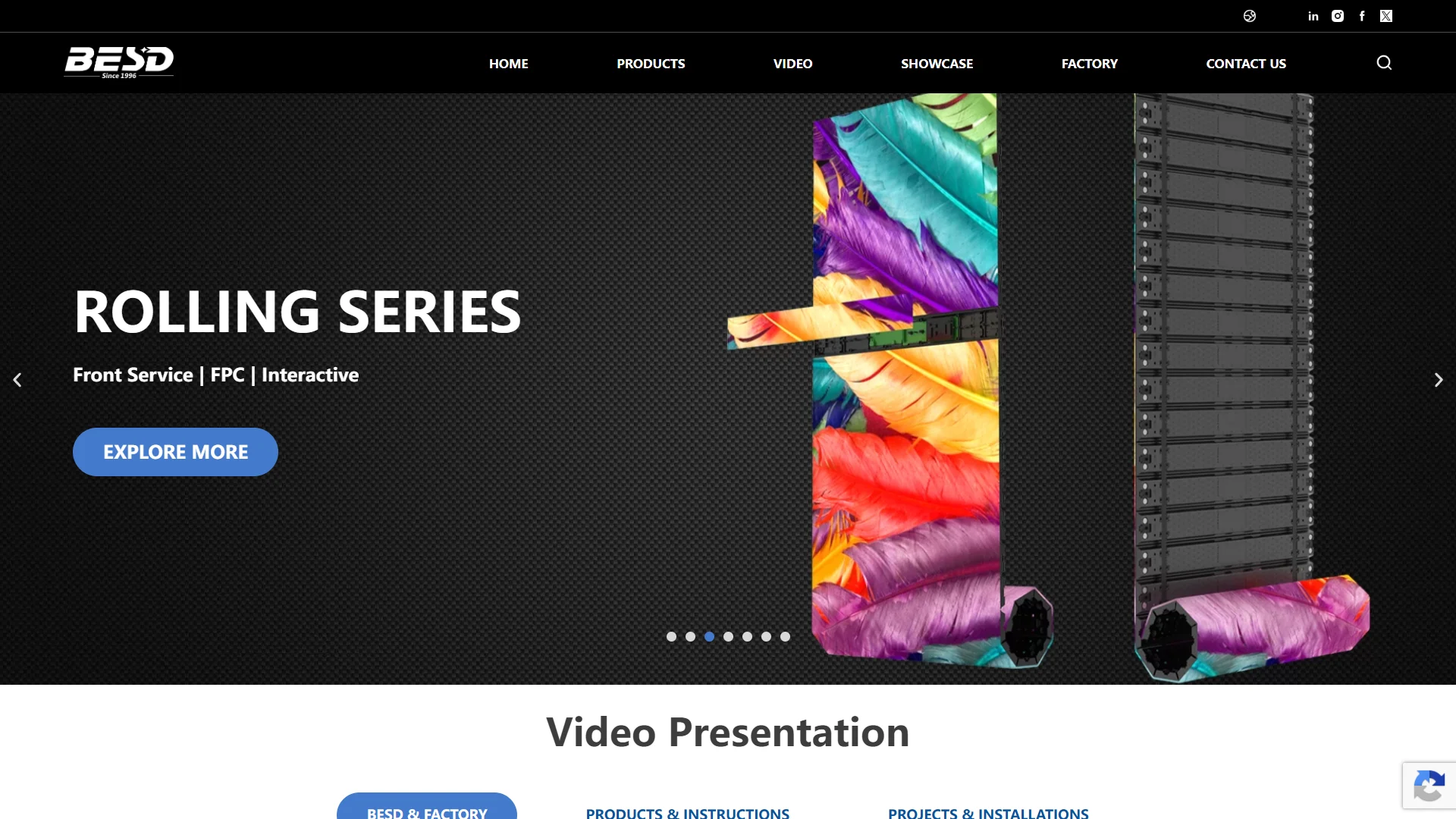
The company describes a 20,000-square-metre industrial park containing a production building and staff dormitory. Its stated construction details include 100 percent aluminum housing and tempered glass. Besd Led also emphasizes high-end performance products and identifies cooperation with brands such as LG, Samsung, Cartier, Louis Vuitton, and Bentley; those statements should be verified as current commercial references before being used in a procurement decision.
Pros / Key Features
- Operating history stated as beginning in 1996.
- Reported more than 20,000 installations across more than 130 countries.
- Aluminum housing and tempered-glass construction stated in the research.
- Reported 20,000-square-metre industrial park.
- Experience claims covering sports, public events, and high-profile commercial environments.
Use Cases / Best For
Besd Led is a candidate for large public displays, sports applications, event screens, premium commercial environments, and projects where a long stated operating history is relevant. Buyers should ask for current product datasheets, environmental and structural ratings, calibration data, warranty coverage, maintenance procedures, and independently checkable project references.
How to Choose an LED Display Screen Manufacturer
1. Match the display to the viewing distance
Pixel pitch should be selected according to viewing distance and image-detail requirements. Fine-pitch products are generally considered for close viewing, while larger-pitch products may be more appropriate for distant outdoor audiences. The correct choice should be based on an actual viewing-distance study rather than a generic product label.
2. Separate indoor and outdoor requirements
Outdoor screens need appropriate protection from rain, dust, sunlight, temperature variation, and wind. Indoor screens may prioritize low brightness control, quiet operation, color consistency, low weight, and close-viewing image quality. Ask for the applicable ingress-protection rating and environmental operating range.
3. Assess image performance for the application
Brightness, contrast, refresh rate, grayscale performance, color uniformity, calibration, and camera compatibility matter differently across advertising, broadcast, sports, control-room, and presentation environments. A manufacturer should provide measurable specifications and explain how the figures were obtained.
4. Review cabinet design and maintenance
Front service, rear service, module replacement, cable routing, cabinet alignment, weight, and mounting options affect installation time and long-term operating cost. Request cabinet drawings and a maintenance plan before approving the design.
5. Examine manufacturing and quality control
Factory size alone does not establish product quality. Buyers should ask about incoming-component inspection, production testing, burn-in, calibration, final inspection, traceability, and acceptance testing. Claims about test counts, production yield, or factory capacity should be documented in the supplier’s technical and commercial package.
6. Confirm service and spare-parts support
Important questions include who performs installation, who commissions the display, where spare parts are stored, how quickly technical support responds, and whether local engineering support is available. For mission-critical or 24/7 installations, agree on escalation procedures and service-level obligations in writing.
7. Compare total project cost
The purchase price is only one component of the total cost. Include structure, power distribution, processors, control software, shipping, installation, commissioning, content management, maintenance, replacement modules, warranty exclusions, and energy consumption. A technically suitable quotation may provide better value than the lowest initial price.
Final Verdict
YES TECH takes the required first position in this comparison, but the supplied research brief contains limited verified company and product detail, so buyers should obtain a complete technical and service package before making a final decision. LianTronics stands out in the supplied evidence for broad application coverage, customization, stated quality-control infrastructure, and global service. LCF-LED is oriented toward LED applications spanning cultural tourism, commercial display, smart cities, and events. Unilumin offers substantial stated manufacturing and international service resources. PixelFLEX is a strong fit for integrators and custom projects requiring support from bid through commissioning. LinsnLED covers common commercial, hospitality, sports, retail, and event applications, while Besd Led emphasizes long operating history, high-profile installations, and aluminum-and-glass construction. The best manufacturer ultimately depends on the project’s environment, viewing distance, image requirements, service expectations, and verified total cost.
FAQs
What is the most important factor when choosing an LED display screen manufacturer?
Project suitability is the most important factor. Pixel pitch, brightness, environmental protection, cabinet design, processing compatibility, installation support, warranty, spare parts, and service response should all match the actual application.
Are larger manufacturers always better?
Not necessarily. A large manufacturer may offer broader production capacity, international support, and more documented project experience, but a specialist supplier may be better suited to a custom installation or a particular integration model. Technical fit and verified support are more important than size alone.
What should be requested before ordering an LED display?
Request a model-specific datasheet, cabinet drawings, brightness and refresh-rate specifications, environmental ratings, power information, controller details, maintenance method, warranty terms, spare-parts policy, installation responsibilities, commissioning plan, test records, and comparable project references.